ICON:_Alan Turing]
Visionary, Codebreaker, Machine thinker
ENVISIONING THE INVISIBLE
ALAN TURING AND FLUXUS SONUS
Fluxus Sonus investigates sound beyond conventional musical boundaries, exploring signals, systems, machines, frequencies, communication, noise, and the relationship between information and perception. This is why Alan Turing belongs within its field of inquiry. A mathematician, cryptanalyst, and pioneer of modern computing, Turing changed how we understand information and machines. Although he was not an experimental musician, his discoveries raise questions that remain central to experimental and electroacoustic practice: How does a system work? How can information be transformed? And how can invisible processes become perceptible through sound?
Turing spent much of his life investigating codes, patterns, rules, and the hidden structures that make systems function. For Fluxus Sonus, the connection is direct: sound is also a system of relationships. Frequency, duration, repetition, distortion, and silence can be organized and transformed to create entirely new sonic experiences. A recording can preserve traces of something no longer present, while electronic processing can conceal or reveal the structure of its original source. Sound becomes more than an aesthetic object; it becomes a means of investigating information, perception, and the systems that connect them.
WHEN THE COMPUTER BECAME AUDIBLE
Turing’s relationship with sound has a fascinating historical dimension. While working with early computers at Manchester, he helped establish the programming environment in which machines could produce audible tones. The computer’s loudspeaker, known as the hooter, was initially used to communicate machine conditions to operators. Turing’s 1950 programming material described how the device could generate tones. In 1951, Christopher Strachey used Turing’s programming system to make the Ferranti Mark I computer play recognizable melodies.
The significance extends beyond the emergence of computer music. A machine operation could produce a tone, and information could be translated into an audible event. Sound became a means of communicating what was happening inside a computational system. The machine had become a source of sound, and computation had acquired an audible dimension. This is closely aligned with the Fluxus Sonus approach, in which sound can originate not only in instruments or performances but also in data, electricity, machinery, interference, and the transformation of information.
WHAT WOULD TURING’S RESEARCH HAVE SOUNDED LIKE?
Imagine Turing’s research translated into an electroacoustic environment. Calculations become pulses, repetition becomes rhythm, changes in machine state produce shifts in frequency, and errors emerge as interruptions. Increasing computational complexity generates increasingly dense sonic structures. The result might not resemble conventional music. It might sound like a machine revealing its internal activity, exposing processes normally hidden from human perception.
For Fluxus Sonus, this possibility is particularly compelling. The sound would not merely illustrate scientific research; it would offer another way to experience it. Pulses, drones, crackling signals, mechanical repetitions, and unpredictable sonic transformations could make abstract systems tangible to the ear. This is the creative potential of sonification: translating information and processes into sound, allowing the listener to encounter structures that would otherwise remain inaccessible.
CRYPTOLOGY AND ELECTROACOUSTICS
Turing’s work in cryptanalysis provides another important connection. Cryptology concerns the concealment, transformation, and recovery of information. An encrypted message retains its underlying content while its original meaning becomes inaccessible without the appropriate method of interpretation. The surface changes, but the information remains embedded within a structure.
Experimental electroacoustic practice often explores a similar relationship. A voice can be fragmented, reversed, filtered, stretched, distorted, or layered until its source becomes difficult to recognize. A familiar recording can be transformed into an unfamiliar sonic landscape while retaining traces of its origin. In both cases, transformation changes how information is perceived and understood.
Cryptology conceals information through encoding; electroacoustics can conceal, transform, and reveal information through sound. Both involve patterns, sequences, structures, and the investigation of what lies beneath the surface. The cryptanalyst asks what is hidden inside a message. The experimental listener asks what is hidden inside a sound. For Fluxus Sonus, these questions converge in a shared investigation of signals, meaning, and discovery.
THE INVISIBLE BECOMES AUDIBLE
Turing’s work demonstrated how abstract rules could produce observable results. An algorithm cannot be heard directly, but its operations can be translated into sound. A machine’s internal state may be invisible, yet its consequences can be expressed through changes in frequency, rhythm, or intensity. Likewise, information can become an acoustic event without losing its relationship to the system from which it originated.
This is where Fluxus Sonus moves beyond the conventional understanding of electronic music. Sound becomes a method of inquiry, a means of exploring hidden structures and the relationship between human perception and technological processes. Computation, signal processing, artificial intelligence, and electroacoustic experimentation offer different ways to investigate how information is organized, transformed, and experienced.
TURING’S LEGACY / FLUXUS SONUS
Alan Turing helped establish the conceptual foundations of modern computing, advancing our understanding of information, machines, communication, and intelligence. His work in cryptanalysis demonstrated the importance of identifying hidden structures, while his involvement with early computer programming helped create conditions for the emergence of computer-generated sound.
Fluxus Sonus carries these questions into a contemporary experimental field, examining signals, archives, frequencies, transmissions, algorithms, noise, and artificial systems without imposing conventional boundaries between scientific inquiry and artistic practice. Turing’s legacy offers a way to understand sound not simply as something to hear, but as a structure to investigate, transform, and experience.
Perhaps the most appropriate way to imagine his research as sound is not as a melody, but as an evolving system of pulses, interruptions, patterns, and encoded information moving through an invisible architecture. Turing helped make computation audible. Fluxus Sonus extends that possibility into a broader investigation of what sound can reveal about the systems shaping our world. The central question remains: how does an invisible structure become perceptible?
For Fluxus Sonus, the answer begins with listening. Sound becomes a means of encountering information, discovering patterns, and exploring the boundary between what is known and what remains hidden.
The invisible becomes signal, and the signal becomes sound.
ALAN TURING: CRYPTOLOGY MELTS INTO ACOUSTICS
The work of Alan Turing within Fluxus Sonus is conceptual and transformative, as his discoveries in cryptology, mathematical logic, and computation provide a framework for exploring the hidden structures of sound and information. His research into codes, patterns, and machine intelligence reveals connections between concealed messages and the acoustic transformations central to experimental practice.
Through this perspective, cryptology and electroacoustics converge as processes of encoding, fragmentation, distortion, and discovery, where information can be obscured, reconfigured, and experienced through listening. Turing’s legacy encourages Fluxus Sonus to investigate how abstract systems might become audible, translating computational logic into pulses, frequencies, interruptions, and evolving sonic structures. His work offers a bridge between the invisible architecture of information and the limitless possibilities of sound, positioning sonic experimentation as a means of decoding reality rather than merely representing it.

| F |^2 * e^(-i*w*t) dt
Alan Turing’s significance for Fluxus Sonus lies in his radical rethinking of how information can be organized, processed, and understood. By developing new approaches to computation and helping break encrypted communications during the Second World War, Turing demonstrated that complex systems could be penetrated through the recognition of underlying patterns. This principle opens an intriguing territory for sonic investigation, where encrypted signals, machine-generated sequences, electronic interference, and acoustic data become material for experimentation. His work invites us to listen to information as a process rather than a message, discovering the sonic potential of codes, calculations, and computational behavior.


Artist Gallery

Alan Turing (left) with school friends, Robin and John Wainwright and Hugh Highet, taken at Waterloo Station on the way to the school carriage at Charing Cross Station. (Archives Centre, King’s College, Cambridge, AMT/K/7/3) Photo by: bletchleypark.org.uk

Alan Turing placed second in the 3 mile race at the National Physical Laboratory, Boxing Day 1946 (Archives Centre, King’s College, Cambridge, AMT/K/7/8) Photo by: bletchleypark.org.uk

Many famous Codebreakers including Alan Turing, Gordon Welchman and Bill Tutte were found this way.
Photo by: bletchleypark.org.uk
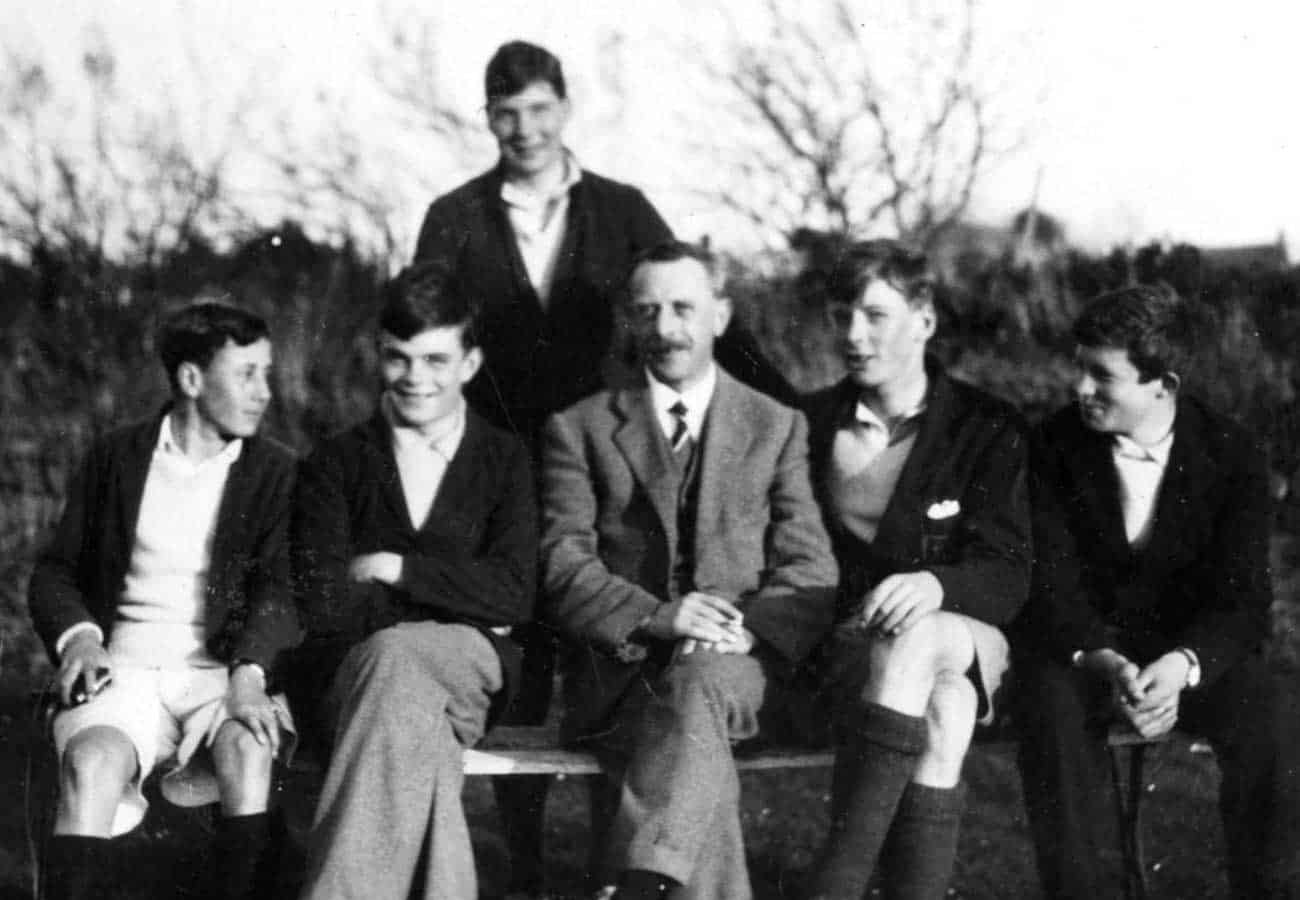
Turing (seated second from left) in Cornwall, with fellow Shirburnians: Edwin Davis, John Bennett, Peter White, Peter Hogg (seated second from right), and Duncan Carse, in April 1930.
Photo by: bletchleypark.org.uk